In Interstellar (2014), there is a line of dialogue often dismissed as pure sci-fi poetry: love is the one thing that transcends time and space. Yet, if physics relies on gravity to hold the universe together, history proves that humanity relies on care and connection as the fundamental building blocks of its progress.
In today’s corporate boardrooms and traditional financial institutions, however, “love” has been largely reduced to a passive noun—a fleeting sentiment or a soft public relations buzzword. We have been conditioned to view economic progress through a strictly transactional lens, prioritizing extraction and efficiency above all else. The result is a world facing a profound systemic crisis, marked by climate instability, biodiversity loss, and deep social fragmentation.
A Snowballing Global Momentum
Fortunately, the realization that we cannot fix this crisis using the same extractive machine is snowballing into a massive global movement. Last year, at One Impact Week 2025, the conversation firmly anchored on “Co-Creating a Well-being Economy.” This momentum reached a boiling point earlier this year at Climate Hub Davos, where Supernova Ecosystem – Equator Capital joined forces with partners like Koalisi Ekonomi Membumi to highlight how localized nature data must be utilized to empower business and unlock regenerative finance.
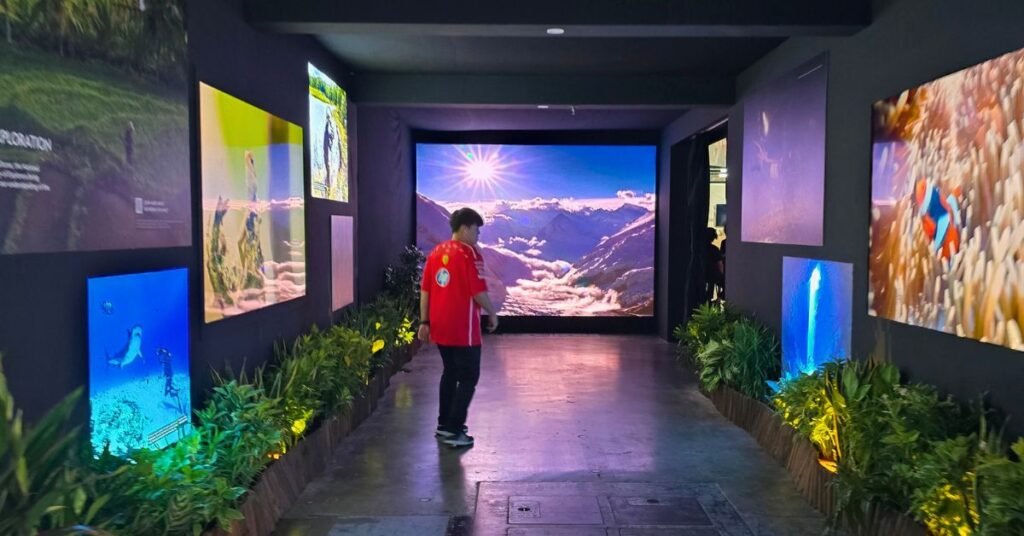
Last week, from September 8-12, our team returned to Singapore to join global changemakers at the At One Impact Week 2026. And this week, the conversation echoes further at New York Climate Week 2026, driven by the theme “Energy. Impact. Action.” The consensus across these global stages is clear: we need a complete systemic redesign.
It was at At One Impact Week 2026 that a radical, beautiful curveball was thrown into the center of this movement: What if love became infrastructure?.
Love as a Verb: Architecting the Economy
This premise challenges us to reclaim love as a verb—an action. Care cannot bring structural change if it remains mere lip service; it must be codified into how we design our systems.
A truly effective systemic infrastructure must be capable of sustaining civilizations across deep time. When capital is explicitly structured to regenerate ecosystems, and when communities collaborate in stewardship, love transforms from a moral ideal into a hardwired organizing principle. It becomes the architecture that drives a fundamental cultural shift from “I” (the individual ego), to “We” (aligned values shaping institutions), and ultimately toward “All of Life” (systems aligned with planetary flourishing).
A critical component of this new architecture is the regeneration of Rural Ecosystems. Historically, limited access to capital has forced rural communities into short-term extraction. By redesigning capital infrastructure with blended finance, we can fund interconnected local enterprises and biodiversity restoration, transforming rural communities into the primary stewards of the living systems our future depends on.
Translating Global Paradigms to Local Action: #WeavingValues
For Supernova Ecosystem, the idea of love as infrastructure is not an abstract theory—it is our daily operational mandate. We translate this pragmatically through our #WeavingValues initiative.
We recognize that traditional, customer-centric business models are obsolete; it is time to shift toward an ecosystem-centric approach. Through #WeavingValues, we actively advocate for the transition from the conventional Business Model Canvas (BMC) to holistic frameworks like the Value Chain Collaboration Canvas (VC3)—which we call the Gotong Royong Value Chain—and the Jurisdictional Approach. Action without foundational care is just motion. To truly build a new economy, we must align economic incentives directly with conservation.
Proof Over Promises: The Impact on the Ground
Debating theory is no longer enough. Our story of #WeavingValues is explicitly designed to validate this narrative with undeniable proof from the field.
When we facilitate the development of sustainable supply chains, such as the Tengkawang (illipe nut) ecosystem in West Kalimantan, we are actively regenerating rural landscapes. When we empower resilient founders through the Konstelasi Accelerator and bridge critical funding via Equatora Capital, we are redefining impact investing in Indonesia. Every success story we champion proves that business can, and must, be a force for life within a regenerative economy.
The Way Forward: Time for Execution
We are past the era where sustainability was just an inspiring panel discussion. It is time for rigorous execution.
The journey toward an inclusive, restorative economy requires a massive, collective effort. We invite impact investors, ecosystem partners, policymakers, and business actors to abandon extractive transactions and start weaving life-affirming values into the very fabric of our national economy.
To explore how we are executing this idealism into measurable social and ecological impact, download our latest Milestone Report on our website. Examine our blueprint, review our field results, and join us in building an economic infrastructure where care is, undeniably, our most powerful foundational asset.